

This article explains, in simple terms, how to read acoustic reports correctly and how to avoid the most common misunderstandings.
What are the leading acoustic standards?
Acoustic performance of wastewater systems is assessed using two fundamentally different standards, each designed for a specific application, together with a calculation framework to predict acoustic behaviour in real buildings. Understanding this distinction is essential when interpreting acoustic data and applying it correctly in projects. The following standards are used:

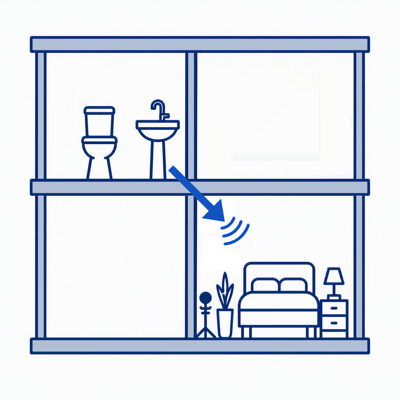

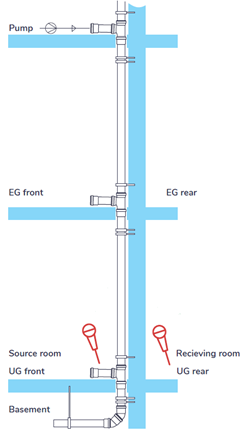

An important update in EN14366:2023 is the extension of the measurement range, starting at 50 Hz instead of the previous 100 Hz. Low-frequency noise travels further and is harder to dampen, especially in lightweight buildings. Because of this shift, the reported sound levels in the 2023 version often appear higher, even though the product itself has not changed. The difference is simply a result of the broader measurement range capturing more low-frequency energy.
In addition, the revision introduces new parameters for airborne and structure‑borne sound, such as free velocity, blocked force, and mobility. These values serve as essential input for EN12354‑5, enabling more accurate prediction of sound levels in both heavy and lightweight buildings.
How to compare EN14366 revision 2005 to 2023?
When comparing the Fraunhofer acoustic report tables from the 2005 and 2023 versions of EN14366, it is important to align the correct parameters.
- The LAeq,n value “following DIN4109” can be compared with row 2: LAeq,n (100–5000 Hz).
- The LAeq,nT value “following VDI4100” can be compared with row 4: LAeq,nT (100–5000 Hz).
EN14366 measurements are performed at defined test flow rates, most commonly 2 l/s and 4 l/s, which can sometimes lead to confusion in communication. In practice, 2 l/s is most often used, as it best represents a typical toilet flush. A modern toilet releases approximately 6 liters of water over several seconds, resulting in an average discharge flow close to 2 l/s.

Why comparing values can lead to wrong conclusions
DIN4109 and EN14366 measure different sound characteristics, so their values cannot be compared directly. DIN4109 reports a maximum sound level (LAF,max,n), capturing the loudest moment during a real toilet flush as heard in a neighbouring room (receiving room). EN14366 reports an average sound level (LAeq,n) measured under constant water flow in a laboratory. In simple terms
- EN14366: How loud is the product under controlled lab conditions
- DIN4109: Is the installed system quiet enough for occupants next door
EN 14366 values are typically lower than DIN4109 results because:
- EN14366 measures an average value, not the loudest moment
- The test uses constant water flow, not a real flush
- Installation elements such as sanitary elements, walls and brackets are not included
For this reason, EN14366 values cannot be used as a reference for real buildings. They are intended for internal laboratory evaluation, product comparison and acoustic calculations only.
EN14366 reports sometimes include the wording “following DIN4109”, but this does not mean the test was carried out according to DIN4109. It only indicates that the value is presented in a similar format, not including the toilet and flush tank, pipes and fittings, brackets, drywall or masonry walls, and the installation method. The overview below shows the method for how the values are defined.
|
The DIN4109 ‘according DIN4109’ values present the maximum value (LAF,max,n) of the measurement. The peak indicates the moment of toilet flushing, where a short, high-intensity event occurs in the system. |
|
|
The EN14366 ‘following DIN4109’ values present the average value (LAeq,n) of the complete measurement. A constant flow is characterized by the absence of a peak in the graph. The measured values are averaged over time, creating a smooth and stable curve based.
|

Why this matters in practice
Many professionals unintentionally compare EN14366 values with DIN4109. This often leads to incorrect conclusions, because the standards have different purposes and test setups. EN14366 values are typically lower because they are averaged, use constant flow, and exclude sanitary elements, walls and installation details. For this reason, EN14366 values cannot be used as a reference for real buildings and are intended as informative or for product comparison.
DIN4109, by contrast, reflects on‑site performance in Germany and is legally and contractually binding. It evaluates the complete system, including water supply, drainage, brackets, sanitary elements, wall construction and installation quality.
The Simple Rule to Remember
Never compare EN14366 values stated “following DIN4109” with values measured “according to DIN4109”. They measure fundamentally different acoustic parameters, but are often communicated inconsistently in practice, which can lead to misunderstanding and incorrect interpretation.
Stakeholder relevance of acoustic standards
This checklist clarifies the relevance of the acoustic standards EN 14366 and DIN 4109 for different stakeholders across the building value chain. EN 14366 is a laboratory‑based product test standard, designed to generate comparable acoustic data under controlled conditions and primarily supporting product development and benchmarking. As such, it is not intended for direct use in building design. DIN 4109, in contrast, addresses acoustic performance in buildings with full sanitary system and can be applied when assessing installations within defined construction scenarios, supporting planning, specification and compliance considerations at project level.
|
Stakeholder |
EN14366 |
DIN4109 |
Relevance |
|
R&D / Product development |
✅✅
|
❌ |
EN 14366 provides a standardized laboratory framework enabling repeatable and comparable acoustic assessments to support product development and internal benchmarking. |
|
Sales |
✅ |
✅ |
EN 14366 enables transparent product‑to‑product comparison under standardized test conditions; DIN 4109 supports communication of system performance in installation‑relevant scenarios, subject to project‑specific conditions. |
|
Installer |
✅ |
✅✅ |
EN 14366 enables transparent product‑to‑product comparison, however in some countries the installer is legally responsible for the installation and acoustic performance. Then the DIN 4109 reflects installation‑related acoustic behaviour under defined boundary conditions and supports awareness of the influence of correct system installation on overall sound performance. |
|
Architect |
❌ |
✅✅ |
DIN 4109 addresses acoustic performance at building level and supports design decisions related to occupant comfort and regulatory expectations, rather than isolated product laboratory values. |
|
Planner / Engineer / Designer |
❌ |
✅✅ |
DIN 4109 supports evaluation of compliance with applicable acoustic requirements and contributes to managing project‑related risks associated with comfort, acceptance, and regulatory alignment. |
|
Building owner / investor |
❌ |
✅✅ |
DIN 4109 is relevant for assessing acoustic performance in relation to regulatory conformity, potential liability considerations, and long‑term building quality and value. |
Status Legend
❌ Limited relevance ✅ Relevant ✅✅ Highly relevant
Wavin Sound Brochure and SoundCheck Tool
While acoustic reports provide reliable values based on laboratory measurements, real-life building conditions can vary due to factors such as wall structures, installation quality, and surrounding sounds.
The Wavin Soundcheck tool helps designers and installers simulate the acoustic performance of their projects using reliable product data, supporting better-informed decisions and improved acoustic comfort. For more detailed guidance, you can also explore the comprehensive Wavin sound brochure.

Fill in the parameters of your project and calculate the sound reduction you will achieve with Wavin AS+ or Wavin SiTech+.

Wavin is your project partner
Wavin supplies all the necessary documentation for planning water and drainage installations: tender texts, data for design software, part numbers and Fraunhofer IBP test reports with assessment of individual products and the overall system according to EN 14366 and DIN 4109. Wavin's design department advises on the design phase and delivers the complete sound attenuation package to the partner carrying out the work.
